 放大圖片 放大圖片
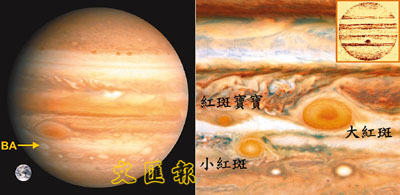
今期又介紹另一個太陽系之最—大紅斑—木星的主要特徵,也是太陽系最大的氣旋(颶風)。大紅斑位於木星的南半球,早在1664年已被英國博學家羅伯特.胡克觀測到,換言之,大紅斑起碼已存在300多年。小圖是1667年刊印,由卡西尼所繪的木星,圖中亦可見大紅斑。100多年前,這個木星超級颶風的尺度達到40,000km,但正逐漸縮小,現時僅長約20,000km,寬9,000km,卻仍可容納整整兩個地球,圖中BA白斑後來演變成「小紅斑」。早在1966年,航行者探測器已發現大紅斑實際是一個反氣旋(反時鐘方向旋轉的氣旋),旋轉周期約為6天,較近期的地面觀測則顯示周期已縮短至約4.5天。天文學家利用紅外線觀測,證實大紅斑的溫度比周圍較冷,並比平均平面高出8公里,是一個隆起的大氣現象。
A super vortex on Jupiter
The Great Red Spot (GRS) is a super hurricane located on the southern hemisphere of Jupiter. The earliest discovery of the GRS could be dated back to 1664, from observations by British naturalist Robert Hooke. In the picture above, the small inset (published in 1667), is a drawing by Giovanni Cassini. The presence of the renowned spot is apparent. At present the GRS measures around 20,000 by 9,000 km and two earth-size planets could easily fit inside it. South of the GRS is Oval BA which eventually evolved into Red Spot Junior. In 1966 the Voyager spacecraft made the first time-lapse movie of Jupiter. It was then that scientists discovered the GRS was a 6-day-period, anti-clockwise vortex. The rotational period has since shortened to about 4.5 days. ■甄枝強 資深天文愛好者
|


 放大圖片
放大圖片



