 放大圖片 放大圖片
早在1974年一艘名為「水手10號」的探測器,先後兩次飛略水星,並拍到45%水星表面地貌。04年8月,「信使號」再次延續停頓30多年的水星探測任務。
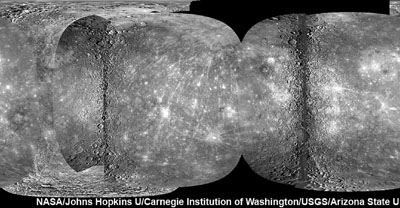
「信使號」預計於2011年進入水星軌道,為何需要經歷這麼長的時間才到達水星?原來一艘飛向內太陽系的探測船會不斷受到太陽引力而加速,若要進入水星軌道,探測器就得消耗大量燃料來減速,這做法既不划算,也難實行。退而求其次,「信使號」會在漫長旅程來回飛越地球、金星和水星多次,並借助這些行星的引力而減速和改變航線。雖然「信使號」還有1年多才到達水星,不過在3次飛越這顆行星中,亦拍得大量照片,加上「水手10號」的數據,我們終能窺視整個水星表面的地貌(圖)。
Next Stop, Mercury
In 1974, the Mariner 10 swept past Mercury and mapped 45% of its surface. In 2004, MESSENGER began its 7-year odyssey to take up where Mariner had left off.
Why does it take 7 years for the craft to reach Mercury? A spacecraft flying into the inner solar system will be continuously accelerated by the gravitational tug of the Sun. It would require an impracticable amount of power to decelerate and enter a stable orbit round Mercury. So instead of flying directly to Mercury, MESSENGER would fly pass the Earth, Venus and even Mercury several times to let the gravitational pull of these planets to slow it down. There is still a full year ahead before MESSENGER reaches Mercury. But with its earlier Mercury flybys and the Mariner 10's data, we are now able to glimpse this hostile world. ■甄枝強 資深天文愛好者
圖片鳴謝:NASA/Johns Hopkins U/Carnegie Institution of Washington/USGS/Arizona State U
|


 放大圖片
放大圖片



