 放大圖片 放大圖片
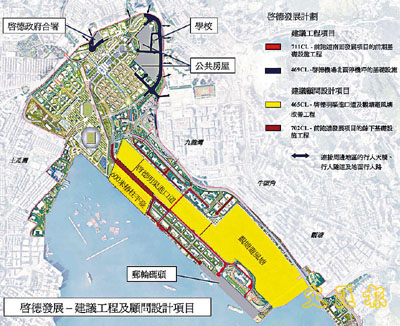
■發展局今年第二季會向立法會申請啟德基礎建設及明渠改善工程撥款,興建道路、行人天橋和排水及排污系統。資料圖片
As the hundred-billion-dollar Kai Tak Development Plan will soon commence, the Hong Kong government has decided to spend more than HK$2 billion to clear the original source of odour emission in the Kai Tak nullah in three ways, namely, sewage interception, biological purification and blowing out the runway. It is anticipated that the project can solve once and for all a problem that has plagued the area for many years and that by 2015/2016 odour will be completely eliminated and water purified.
The Kai Tak waterway has accumulated considerable organic matters, resulting in a very low level of oxygen content. When micro-organisms break down organic matters in an anoxic (absence of oxygen) condition, hydrogen sulphides, which smell like rotten eggs, will be produced. Leung Wing-yuen, senior engineer of Civil Engineering and Development Department said that the Drainage Department will start the Kowloon City sewage interception scheme at the upper part of the Kai Tak waterway in the middle of the year.
Apart from sewage interception, the government will make use of a biological and chemical treatment process in the next two years to deal with the sludge accumulated over an area of approximately 28 hectares in the nullah. Mr. Leung Wing-yuen pointed out that one kilogram of sludge on the seabed of the nullah contains 500 to 7,000 milligram of sulphides. He said that in the two experiments carried out in the past two years, the government, adopting the water quality improvement method used in the Shing Mun River, injected calcium nitrate to the sludge over an area of approximately 4.5 hectares; and as a result, the amount of sulphides was decreased by 95% and the odour greatly reduced. The full-scale project is expected to start in the year 2011/2012, during which the sludge in the Kwun Tong Typhoon Shelter will also be treated as a sideline.
In addition, the government plans to blow out an opening of about 600 meters below the former Kai Tak runway. This will accelerate the flow of water and facilitate sludge scrubbing. Nullah is a narrow waterway, as explained by Mr Leung, the ebb and flow in the Victoria Harbour has no significant effect on scrubbing off the sludge. According to an analysis performed by a computerized model, if an opening to the size of 600 meters is made, sea water will flow from the To Kwa Wan Typhoon Shelter to the nullah during ebb tides and then to the sea via Lei Yue Mun. ■translated by 開明
|


 放大圖片
放大圖片



