 放大圖片 放大圖片
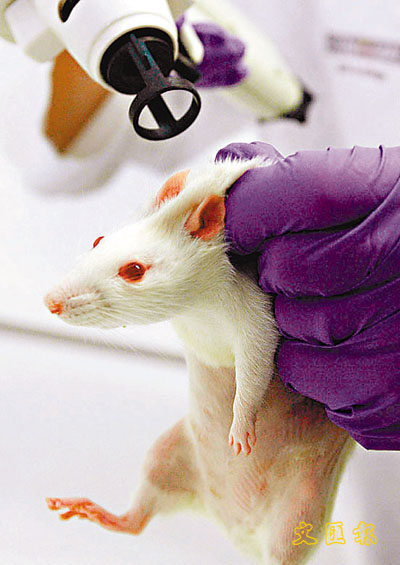
■杜克大學醫學中心的科學家以老鼠作電流實驗,發現電擊後狀況如帕金遜病人的老鼠能正常走動。 資料圖片
Implanting a pacemaker-like device deep in the brain helps some Parkinson's disease patients move better, but could less risky zapping of the spinal cord work instead?
It did in mice and rats nearly immobilized with Parkinson's-like symptoms: Scientists at Duke University Medical Center turned on the electricity and videotaped the rodents immediately scurrying around almost like normal. The research is just a first step. More animal testing is needed to tell if the approach could be tried in people.
But sufferers of chronic pain already can have spinal cord stimulators implanted that send electrical currents to block the ``I'm hurting'' messages sent to and from the brain. For Parkinson's, the idea is similar.
Exploring a less invasive approach, the Duke team attached tiny wires to the spinal cords of mice and rats whose brains produced so little dopamine that they had the slow, stiff motions of advanced Parkinson's disease. When the electricity was turned on, the animals became 26 times more active and movement visibly improved in seconds, Duke neuroscientist Dr. Miguel Nicolelis and colleagues wrote.
Proper movement requires orderly nerve cell firing to different muscles at different moments in time, like members of an orchestra must play in proper sequence for a symphony.
There is increasing if circumstantial evidence that rhythmic waves of brain activity, called oscillations, play a role in Parkinson's movement problems — and that interrupting those abnormal waves allows the more normal, symphony-like brain cell firing to resume, said Dr. Walter Koroshetz, deputy director of the National Institute of Neurological Disorders and Stroke.
The spinal cord stimulation appears to have sent a signal up to the brain that interrupted those oscillations. Koroshetz cautioned that much work remains, including testing whether the stimulator's effect might last long enough to be useful.
But, "it's something that has definitely got some scientific traction to it," he said, "It's a really good idea." AP
|


 放大圖片
放大圖片



