 放大圖片 放大圖片
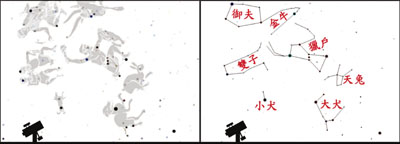
冬夜是認識星空的好時機,只要你在晚上約10時,望向東面的低空,你就可以看見全天最光亮的恆星—天狼星,時間越夜,天狼星升得越高,即使居住在市區,只要沒有遮擋,都可以看見。天狼星是大犬座的主星,大犬和小犬同是獵戶的獵犬。在天狼星的上方,有3顆排成直線的恆星,代表著獵戶的腰帶,找到這3顆星,就不難辨出獵戶座。天文學家是怎樣定義星的亮度?早在公元前134年,希臘天文學家喜帕恰斯在他的星表(也是西方最早的星表)創立了「星等」的概念,他把最亮的20顆星確定為1等星,肉眼可見最暗的為6等星。1856年,英國天文學家諾曼.普森將1等星定義為比6等星亮100倍,即每暗一星等,光度減少2.512倍。
The Winter Hunter
It is time to familiarize yourself with the winter sky. Look east at around 10 p.m. to find the brightest of all stars, Sirius. Sirius marks the head of Canis Major. Both Canis Major and Canis Minor are Orion's hunting dogs. Above Sirius you should be able to see three stars line up in a straight line. They represent Orion's belt. Once you find the belt, Orion is unmistakable. Stars are of different brightness. In 134 B.C., Hipparchus innovated the concept of star magnitude. In 1856, British astronomer Norman Robert Pogson defined that the first magnitude star being brighter than the sixth by 100 times. A decrease in one magnitude meant a decrease of 2.512 times in brightness. ■甄枝強 資深天文愛好者
|


 放大圖片
放大圖片



