 放大圖片 放大圖片
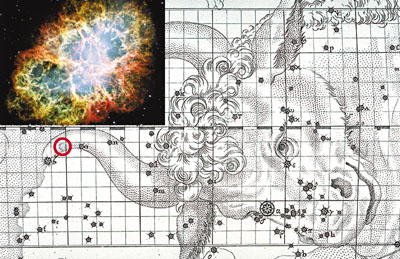
梅西爾1號天體(M1或稱蟹狀星雲)是一個超新星遺骸。當一顆高質量的恒星耗盡它的燃料,就會以一次巨大的爆炸把它的外層大氣拋射至星際的空間。遠在北宋時,中國人便目睹一次這樣的罕有天象。據《宋會要》的描述,在公元1054年,「天關」(星名,即金牛座靠南的牛角)附近出現一顆「客星」,其光度在整整1年零10個月裡維持在晚間達肉眼可見的程度,而在最初的23天更亮如金星,於白晝可見。600多年後,英國業餘天文學家約翰.貝維斯終於找到了這顆超新星暗淡的遺骸,並把它編入他繪製的《不列顛星圖》內(見圖),這就是天文觀測者所熟知的M1,貝維斯的發現比梅西爾早了足足27年。在1968年天文學家發現M1的核心有一顆以0.033秒頻率閃亮的星體,並確證此即為超新星遺留下來的星核。
The Crab Nebula story
The first listed Messier object (M1 or better known as the Crab Nebula) is a supernova remnant. When a massive star burns up its fuel, it ends its life in an explosion. Such a rare event was actually observed by the Chinese in 1054. According to literature, a “guest star” was seen near“Tian-guan”(the southern horn of Tarus, the bull). The star could be seen for 653 days. It could even be seen in broad daylight, just like Venus, for 23 days. 677 years later, John Bevis (British amateur astronomer) swept up its dim remnant and put it in his“Uranographia Britannica”. Bevis discovered the Crab 27 years before Messier did. In 1968 astronomers identified the star core that was left behind after the supernova explosion. ■甄枝強 資深天文愛好者 蟹狀星雲圖片來源:NASA/ESA
|


 放大圖片
放大圖片



