 放大圖片 
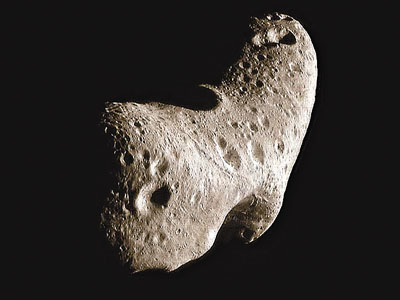
不說你可能不知道,原來除了月球、金星、火星,以至土星衛星泰坦,人類的行星探測器也曾登陸一顆小行星。在2000年4月至2001年2月期間,美國太空總署的「會合—舒梅克號」探測器環繞小行星433號進行探測,並發現這顆小行星表面滿布源自10億年前一場撞擊的石塊,探測器完成任務後,更在其表面軟着陸,千百年後,這顆小行星或會成為一處太空旅遊熱點。小行星433是於1898年8月同一個晚上,分別由兩位天文學家所發現並以希臘神話中的愛神厄羅斯來命名。這顆排行第二大的近地小行星大小約為34.4×11.2×11.2千米,活像一個在太空漂流的馬鈴薯,在2012年1月末,愛神星將會在距離地球0.18天文單位處(相當於地球至月球距離的70倍)飛越而過,讓人類可以一睹她的風采。
Asteroid 433, Eros.
Planetary probes have landed on the moon, Venus, Mars and even one of Saturn's moons, Titan. On February 12, 2001, at the end of its mission, the US NEAR-Shoemaker probe soft-landed on the surface of Minor Planet 433 using its maneuvering jets. 433 was discovered on the same night (13 August 1898) by two unrelated astronomers. It was then named after the Greek god of love, Eros. Eros is the first discovered near-Earth asteroid (NEA). NEAs are objects that may come too close to the Earth, causing alarm. Measuring approximately 34.4×11.2×11.2 km, the second-largest near-Earth asteroid actually looks like a lonely potato drifting in the vastness of space. On January 31, 2012 Eros will fleet past Earth at a distance of just 0.179 astronomical unit, about 70 times the distance to the moon. ■甄枝強 資深天文愛好者 ■圖片來源:NASA/JPL/JHUAPL
|


 放大圖片




