 放大圖片 放大圖片
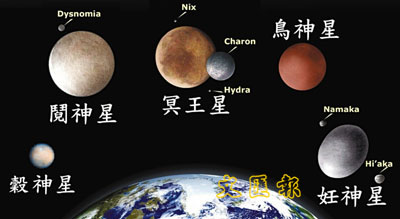
國際天文聯會於2006年通過了一項重要的議決,把繞著太陽運行的細小球狀天體定義為矮行星,此項決定導致冥王星最終被踢出行星行列。不過更戲劇性的還是小行星一號穀神星的重新定位。當穀神星於1801年被發現時,天文學家還以為這就是運行於火星與木星軌道之間,未被發現的行星;次年,英國天文學家威廉.赫歇爾發現它非常細小,把它歸屬為新的天體類別──小行星。現今已確定的矮行星共有5顆,除冥王星和穀神星,其餘3顆分別是鬩神星、鳥神星和妊神星。前二者均由米高.白朗為首的一群天文學家所發現,其中鬩神星是現今距離太陽最遠和最大的矮行星。矮行星雖然細小,但冥王星、鬩神星和妊神星均擁有衛星(見圖)。至現時為止,只有冥王星和穀神星被望遠鏡拍到它們模糊的表面特徵。
The smaller bodies of the solar system
In 2006 the International Astronomical Union adopted a new astronomical term, dwarf planet, which defines a small spherical body that circles the sun in its own orbit. This brought the downfall of Pluto which formerly held the ninth planet name card. But nothing was more dramatic than reclassifying Ceres, precursor of the minor planet family. When Ceres was discovered in 1801 it was thought to be the missing planet that wandered between the orbits of Mars and Jupiter. Besides Pluto and Ceres, there are three newly discovered dwarf planets. They were Eris, Makemake and Haumea. The former two were found by Michael Brown's team of astronomers. Dwarf planets may be small but some of them have satellites of their own too(see picture above). ■甄枝強 資深天文愛好者
|


 放大圖片
放大圖片



